
I hardly know where to start, it’s been quite a year! The biggest art project I’ve been working on for the last several years has finally come to (almost) completion: a children’s book about orcas, written by Gloria Snively, with whom I’ve collaborated on four other books. We decided to self-publish this one, and currently it’s wending its way through the labyrinth of that process, which has been complicated for everyone due to the sheer number of illustrations — about a hundred in total, from many full colour paintings to even more of the smaller spot illustrations.
A week ago, I travelled to East Sooke to help Gloria with a presentation about the upcoming book to her neighbourhood environmental group. My part was to show the process of making a painting from the book, and I made a PowerPoint* (which I’m only a beginner at, so these are simple). It occurred to me that making the slides for it was pretty much like making a blog post tutorial, so here it is, doing double duty!
*Actually I do these in Keynote, the Apple answer to PowerPoint, and then export them as PowerPoint files!
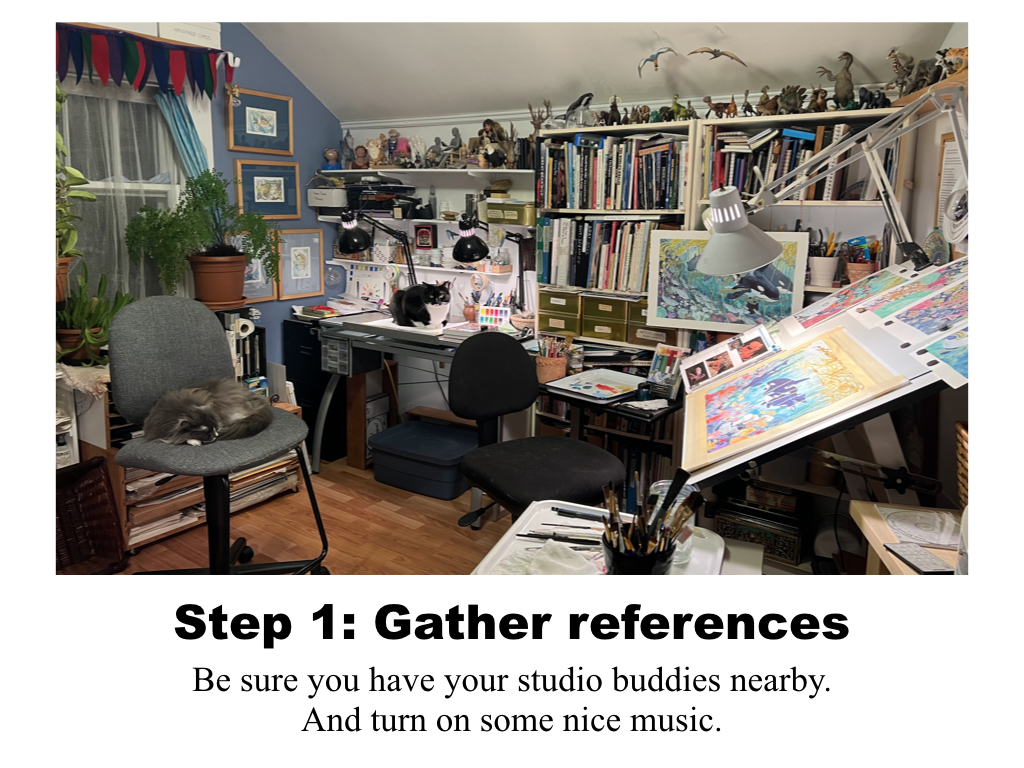
I didn’t think to start taking pictures until partway into the process. The photo above was taken when the painting was just about finished, and shows some of the ton of reference material I was drawing from. I used everything from books (I have acquired a LOT of books about sea critters in the course of these projects!) to YouTube videos to even referencing my own past artwork to help me remember how I solved similar problems in the past.
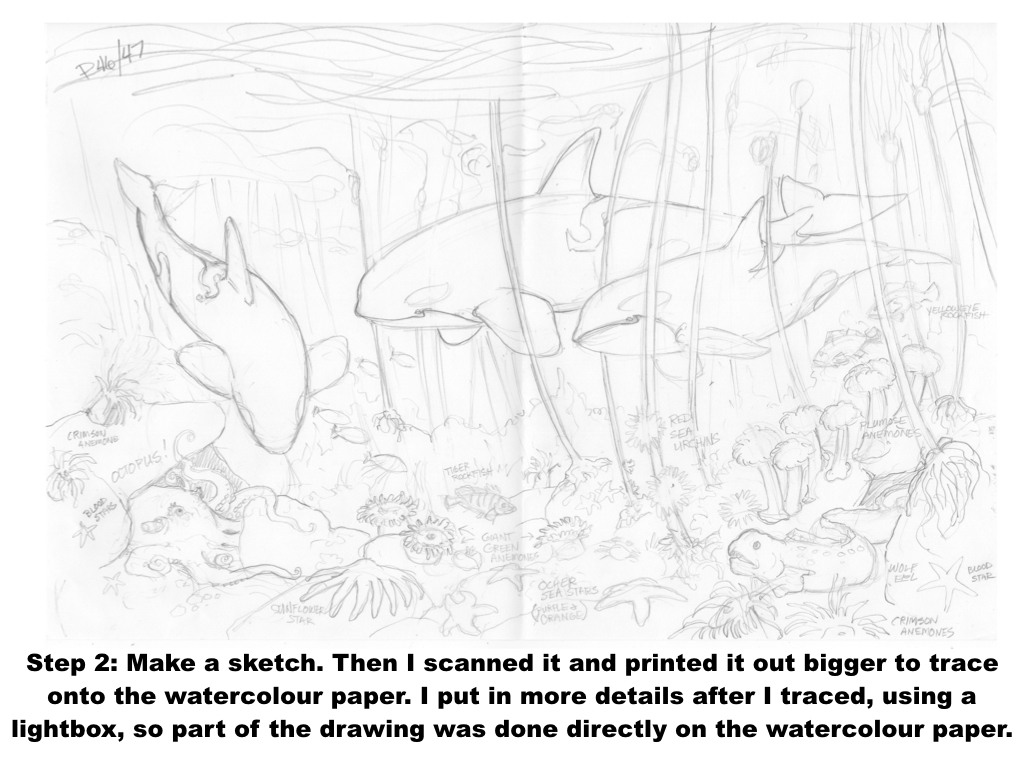
I think this one’s pretty self-explanatory, but if you don’t know what a lightbox is, it’s a box with a translucent top and lights inside. I made my first one out of scrap wood, scrap plexiglass, and an old fluorescent light fixture. The one I have now is much sleeker and modern, and uses LEDs. You can see my tuxedo cat, Arthur, sitting on top of it (it’s not lit) in the first photo.

As I said, I forgot to start photographing until I got partway into the painting. Because these are photos and not scans, and just done with whatever the lighting condition was at the time I was taking the picture, these vary a bit in colour temperature. In the image above, you can see that I had refined the pencil sketch quite a bit before starting to lay the paint down.

I’m not going to publish a playlist, because this was a long project (and anyway, I didn’t think to write it down) but mostly I like to listen to instrumental music when I’m doing things I have to concentrate hard on. I have a large collection of Celtic fiddle tunes by many different artists (many of them local), and that always helps me feel happy and focussed when working.

I was itching to get to that background kelp forest, partly because it was easier than the foreground, and partly because I love creating depth by overlapping shapes and fading the colours in the distance.

Actually I was procrastinating having to paint all those fiddly life-forms in the foreground, haha!
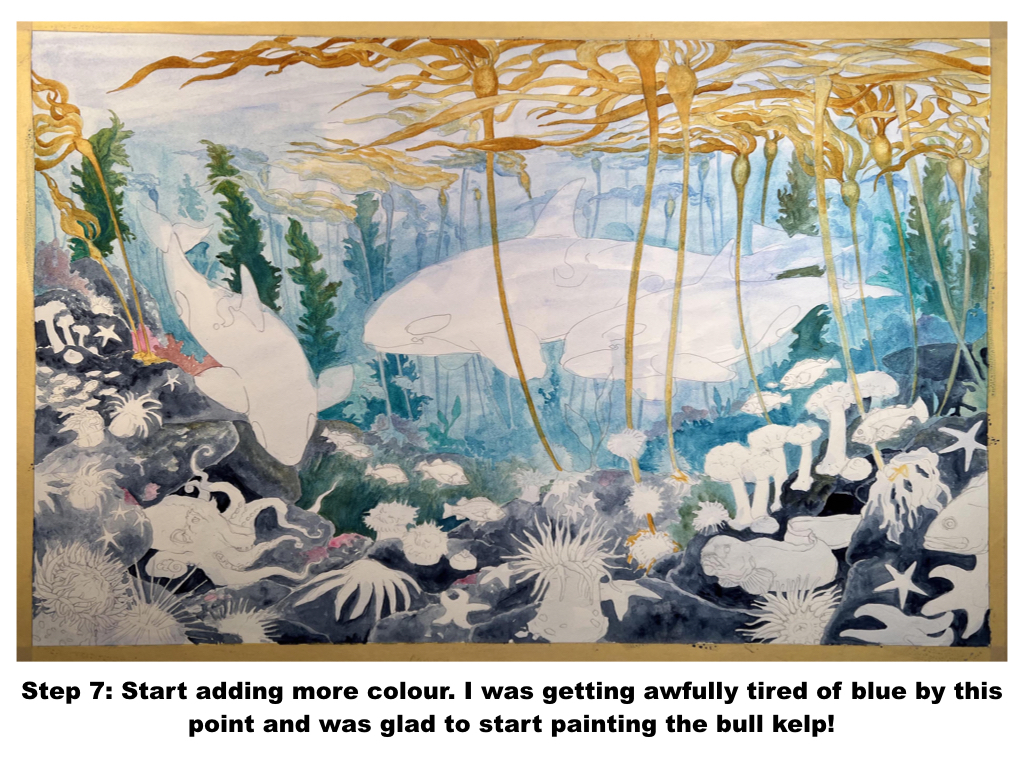
Anything to procrastinate the foreground a bit longer…

This is where I really started to feel it coming together. There’s a point in every painting where it sort of hangs in a liminal state of working/not-working. Schrödinger’s painting, if you will. And instead of the act of observation affecting the fate of a kitty, it’s generally the act of painting one small part that brings the painting to life.
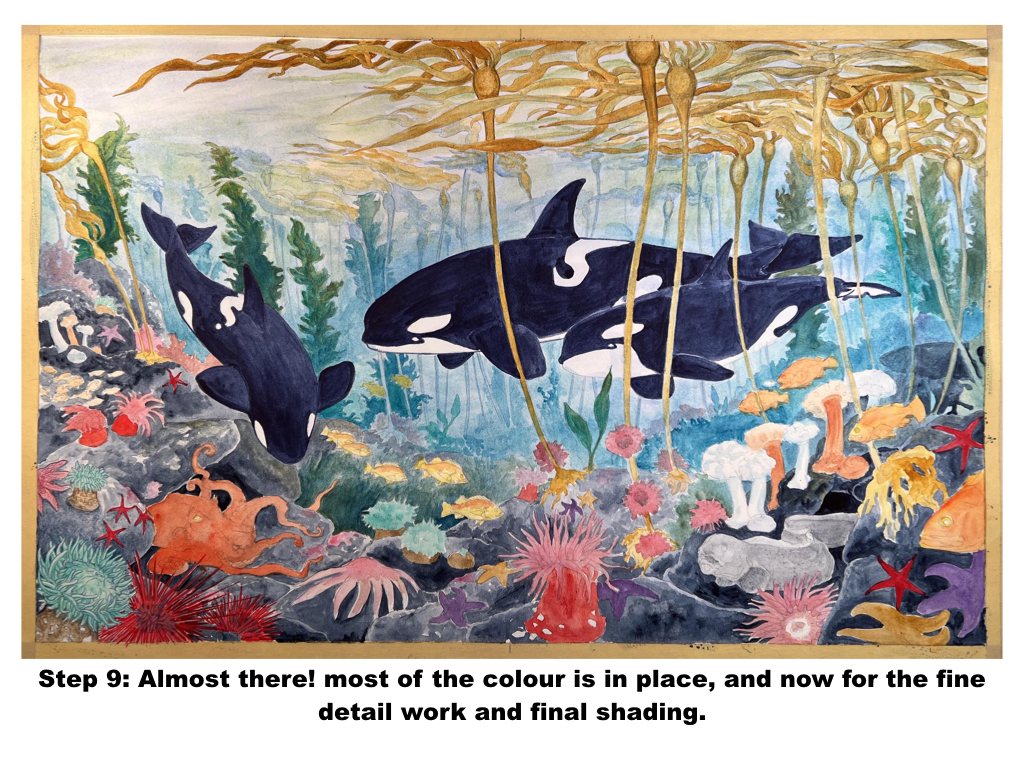
I finally gritted my teeth and started working on the little sea critters. We have such colourful underwater fauna here in the cold seas off Vancouver Island!

This is the most fun part for me, putting in the finishing touches!

I was a little bemused when I saw how much different the photos looked from my final scan, as a result of the variable lighting. But scanning all of these would have taken quite a bit of time; the painting is a large one and has to be scanned in halves, then stitched together in Photoshop, which takes even more time.

The illustration was intended to have text superimposed over the upper part. Most of the books in this series have at least one illustration where creatures are identified like this for teaching purposes.
I hope you’ve enjoyed this journey through the creation of a painting for book illustration! I’m happy to answer questions in the comments, and you’re welcome to just pop in and say hi. I know it’s been a while since I’ve posted, and I’m planning to do more of this kind of tutorial-ish thing soon!
 Karen Gillmore Art
While I’ve never used a light box, I have, in the past, enjoyed playing with my Mammaw’s Magnajector. It had internal mirrors, a light bulb, and a lens. Placing an image under the open bottom of the contraption (upside down, if you were standing directly behind it) would project the image onto the wall or whatever vertical surface you chose (upright, of course).
LikeLiked by 1 person
Hi Karen,
Great to hear you’re back to doing what you love!
I’m in Ontario now and be back Christmas Day. Hope to see you soon, in the new year or before.
Best wishes, Joan
LikeLike